Dr. Steven Narod holds many academic titles that demonstrate his consuming interest in breast cancer prevention and screening. Thus, academic positions such as Professor in the Dalla Lana School of Public Health and the Department of Medicine at the University of Toronto indicate interest in both the epidemiology of breast cancer, as well as treatment strategies.
Importantly, he is a detective when it comes to Big Data, and has pulled out some remarkable findings, culminating in “landmark” publications. He has written more than 550 peer-reviewed articles, while the importance of those papers is reflected by an “h-index” of 85, making him the most widely cited breast cancer researcher in the world.
The h-index is generated by computer searching of nearly all the major medical journals to see how often one is cited by others. Cranking out a large number of papers is relatively easy, but how important are those papers? The h-index reveals how often one’s peers quote the author’s published papers. (I devoted a chapter to the h-index in my book, “Best of the Breast Cancer Blogatorials.”)
10 years ago, Dr. Narod et al published shocking results for women with ductal carcinoma in situ (DCIS) that were so difficult to believe, many breast specialists simply chose to ignore the inexplicable findings. By analyzing a well-known database (SEER), he studied 108,196 women with DCIS, focusing on the 956 who later died of breast cancer. OK so far. But then, he found that 517 of the 956 were never diagnosed with invasive disease. They apparently went from DCIS to metastatic breast cancer in one jump. His conclusion was that the overarching biology of breast cancer is different than what we’ve been saying, and that (my words follow) counseling patients with phrases like, “DCIS is not really cancer” or “DCIS is 100% curable” or “DCIS is noninvasive cancer that is no threat to your health” is terribly misguided.
As harsh as those numbers appear at first glance, the study was addressing a very small portion of the total. Less than 1% of DCIS patients died, and it didn’t matter if patients had a mastectomy or breast conservation originally. The implications, though, were huge due to the fact it indicated DCIS could metastasize without evidence of invasion. That is, malignant cells usually trapped inside the duct could squeeze through the basement membrane and travel elsewhere.
An explanation for the bizarre findings prompted me to email Dr. Narod to let him know of our experience in patients with DCIS, studied with pre-op breast MRI under the direction of Dr. Rebecca S. Clinton. We had just published what was then the largest series of pre-op MRI in patients with DCIS. MRI revealed invasive cancers separate from the known DCIS site. The most dramatic finding was when those “unknown” invasive cancers occurred in the opposite breast from the known DCIS as it meant the invasive cancer would be left untreated (unless the patient underwent bilateral mastectomies). While “opposite side invasion” only happened 2% of the time, it still was/is concerning because it meant surgeons were, in effect, operating on the wrong side for DCIS every 50 patients. For a busy breast surgeon this “wrong side” surgery would occur every 2-3 months and could possibly impact survival. Thus, our answer to the Narod data was to perform pre-op MRI on all newly diagnosed patients with DCIS.
The email conversations with Dr. Narod continued (I never met him face-to-face). In our email chats, he plotted out why “elsewhere invasion seen on MRI” was not enough to explain his findings. We went back and forth for a while, then the conversations ended. Even if the conclusion were valid, however, no one was going to deliver chemotherapy to patients with DCIS when the mortality chances were less than 1%. The best we can do is make sure there is no “elsewhere” invasion using MRI, at least in my opinion.
A few years later, I received an email from Marc Lippman, MD, one of the pre-eminent breast medical oncologists in the world, and at that time, he was Editor-in-Chief of the prestigious journal, “Breast Cancer Research and Treatment. I did not know Dr. Lippman, and I had to consider the possibility that I was reading spam.
Dr. Lippman informed me that Dr. Narod had taken his findings from 2 years earlier and had formulated a new theory of breast cancer biology. Overarching biology of breast cancer is of critical importance in screening research as tumors must be vulnerable to early detection. At the time of screening, however, we don’t have any information about the tumors to be found, so we base recommendations on breast cancer as an “overarching” whole (this is the mirror image to “precision or personalized medicine” where a great deal of information is generated AFTER the diagnosis).
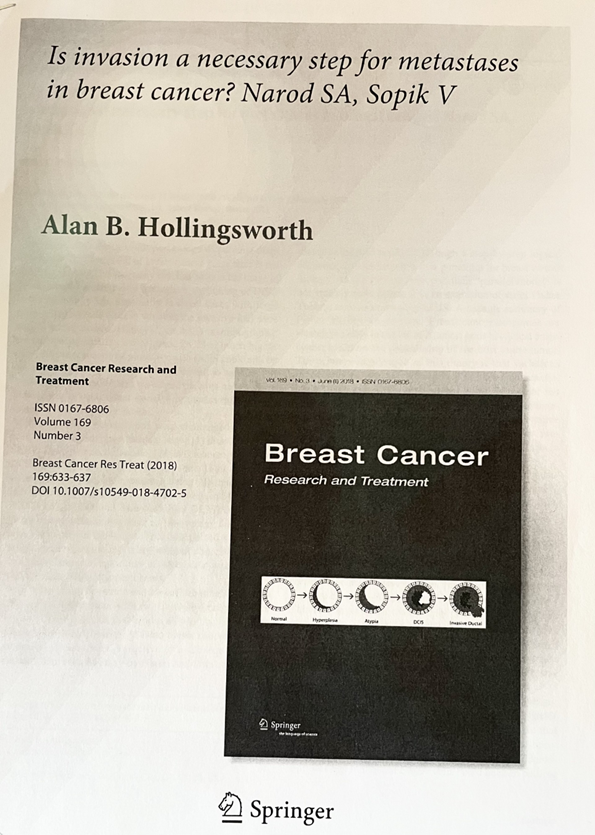
Dr. Lippman informed me that Dr. Narod had requested that I write the Commentary to Narod’s paper. In this article, he was proposing a new way of looking at the biology of breast cancer, called the “parallel model.” When it comes to invasive breast cancer, whether surgeons know it or not, a “lumpectomy” is based on Fisher Theory. But even Bernie Fisher admitted his work applied only to invasive breast cancer. “There is no paradigm for DCIS,” I heard him say once circa 1992. But now, Dr. Narod was attempting to correct that deficit with a “new biology” that included DCIS.
In our conversations two years earlier, I’m sure he picked up on the fact that I had studied every discipline as related to DCIS and was fluent in pathology, surgery, radiology, molecular biology, screening epidemiology, risk stratification, and genetic testing. And when a major article is about to be released, journal editors will often publish a “response” or “commentary” from someone in the same field.
And that’s where I came in — a writing assignment given to me by Marc Lippman, MD at the request of Steven Narod, MD. I was in the private sector at the time, my academic credentials long gone. Admittedly, however, my interest in writing (both medicine and novels) had paved the way for many opportunities, so my actual practice was decidedly academic.
Though only 4 pages long, I’ve never spent so much time and effort in a medical-related article. I drew upon electron microscopy studies that had been done 50 years ago yet subsequently forgotten. I drew from the published vagaries of pathologic sectioning of DCIS where inadequate sampling misses the invasive component. I pulled out everything I had read for the past 30 years. This was NOT done to negate the new theory proposed by Dr. Narod, rather, to offer other explanations.
This scrutinizing approach is in keeping with the research philosophy of Dr. Richard Feynman, a Nobel Laureate in Physics (but known more for his wit and wisdom), who said something like this many years ago: “When you’ve completed your experiment and you got the exact results you were expecting, then stop and try to think of every other possible explanation for your findings other than your own hypothesis.
So, my approach was amicable, yet decidedly slanted toward a multi-factorial origin for the findings. My commentary takes the form a published article in its own right (see attachment), complete with references, etc., and it “counts” as a published paper. Yet, everything in print is in response to Dr. Narod’s paper.
I submitted the article to Dr. Marc Lippman, having no idea what to expect. I had been writing commentaries and editorials my entire career, mostly on breast MRI for screening and pre-op staging, so I anticipated many corrections to be made, outlined in the response. Remarkably, Dr. Lippman’s response was so laudatory that I even showed it to my oft-skeptical wife since it would be hard for anyone to believe — “…wonderful job…excellent…in fact, beautiful….” then onward with praise for the multidisciplinary approach of merging so many disciplines into a single polemic. (Beautiful is not an adjective I’ve seen used in cancer literature.)
Enough bragging. Dr. Narod’s landmark article was the “cover story” for that issue of Breast Cancer Research and Treatment, with my paper following. I retired two years later and never heard another thing about the controversy.
Fast forward 7 years, and I’m now retired from patient care, though still collaborating on a blood test for screening (where DCIS results are closely monitored). I still attend the annual San Antonio conference where 12,000 researchers and oncologists meet every December. Since my collaborators are based at the University of Alberta, it’s a good place for us to meet face-to-face. (most of the attendees from 100 countries are doing the same thing)
This past year (December 2025), I was attending one of the small break-out groups (small is measured in the hundreds), that was addressing the “dormant cell theory” as if that were something new (Bernie Fisher demonstrated the phenomenon in rats in the 1950s, helping to solidify his now-famous theory of breast cancer biology).
As I was sitting there waiting for the presentation to begin, I saw a middle-aged man (nowadays I call this,”young”) walking briskly toward me, eyes fixed as if expecting recognition on my part. I had never seen the guy before in my life, but I could tell he was getting ready to engage me. I flipped through the memory banks but could not come up with anything. He looked a bit like Tracy Letts, Pulitzer Prize winner, playwright and actor from Oklahoma (and the son of Billie Letts).
As the man got closer, he barely smiled, but he stuck out his hand in preparation to shake. I stood up. He spoke first.
“Well…here’s someone I should know.”
I glanced at his name tag, but couldn’t read it. Now we were shaking hands.
“Steven Narod,” he announced.
I had to chuckle at the thought of our 10-year history without ever having met. After a bit of small talk, he said, “When I make my presentations, I include your comments and your position, but I also point out that while you are 10% correct, I am 90% correct.
The lights went out, the speaker began, and we took our seats. Dr. Narod left before the talk was over.
 Early Breast Cancer